Your eight-year-old comes home from school quieter than usual. Something feels off, but when you ask what's wrong, you get a shrug and "I'm fine." Over the next few days, you notice the pattern continuing, withdrawn at dinner, snapping at their sibling, trouble falling asleep. You know something's bothering them, but without understanding the pattern or having the right tools, you're left guessing. This is exactly where teaching emotional intelligence to children becomes not just helpful, but essential.
Emotional intelligence isn't a soft skill that's nice to have, it's the foundation for nearly everything that matters in your child's life. The ability to recognize their feelings, manage big emotions, and understand others will shape their friendships, academic success, and mental health for decades to come. And unlike many aspects of parenting that feel out of your control, this is one area where your daily influence makes an enormous difference.
The good news? You don't need special training or expensive programs. What you need are practical strategies you can start using today. This guide walks you through seven proven approaches for developing emotional intelligence in children, from building emotional vocabulary to tracking patterns that reveal what's really going on beneath the surface.
Understanding Emotional Intelligence and Why It Matters for Your Child
Emotional intelligence, or EQ, is your child's ability to recognize, understand, and manage their own emotions while also recognizing and responding to the emotions of others. It breaks down into five core skills: self-awareness (knowing what you're feeling), self-regulation (controlling impulses and reactions), empathy (understanding others' feelings), social skills (building relationships), and motivation (pursuing goals despite setbacks).
The research is clear. Kids with higher EQ perform better academically, form stronger friendships, and experience lower rates of anxiety and depression. They're better at resolving conflicts. They bounce back from disappointments faster. And they're more likely to ask for help when they need it.

Ages 4 to 14 represent a critical window. During these years, your child's brain is rapidly developing the neural pathways that govern emotional regulation and social interaction. The skills they build now, or don't build, will shape how they handle stress, navigate relationships, and pursue their goals for decades to come.
Here's what matters most: EQ predicts success better than IQ does. A child with average intelligence but strong emotional skills will typically outperform a high-IQ peer who can't work well with others or manage frustration. That's because most of life's challenges, from group projects to job interviews to marriage, require emotional competence, not just cognitive ability.
But schools don't teach this. Most kids learn EQ (or fail to learn it) through trial and error, observation, and the quality of their relationships at home. Which means you have more influence over this crucial skill set than anyone else in your child's life.
Once you understand why emotional intelligence matters, the next step is giving your child the words to express what they're experiencing.
The Foundation: Building Emotional Vocabulary in Daily Conversations
Most kids get stuck at "fine" when you ask how they're feeling. That's because we've given them three words to work with, happy, sad, mad, and expected them to describe an entire emotional universe.
Start expanding that vocabulary early. Frustrated isn't the same as angry. Overwhelmed feels different than scared. Disappointed carries its own weight. When your five-year-old can say "I feel left out" instead of just melting down, you've given them a tool they'll use for life.
Emotion charts work, but only if you actually use them. Stick one on the fridge. Point to it during breakfast. "I'm feeling anxious about my presentation today", then show them where anxious lives on the chart. You're teaching by doing.

The hardest part? Making space for the ugly feelings without trying to fix them immediately. Your kid says they're jealous of their friend's new bike. Don't rush to "but you have so many nice things." Just sit with it. "Jealousy is hard. Tell me more about that."
Turn "how are you feeling?" into a real question, not a greeting. Evening check-ins at dinner. Morning check-ins on the drive to school. Make it routine enough that answering honestly becomes automatic.
Building vocabulary helps your child name their feelings in the moment, but understanding patterns requires a different approach.
Tracking Emotional Patterns: Using Data to Understand Your Child
You notice your child seems "off" lately. But when you try to pinpoint what changed or when it started, everything blurs together. That's where systematic tracking changes the game.
Consistent observation reveals patterns that vanish when you only look at isolated moments. A single bad morning tells you nothing. But when you track mood, energy, sleep quality, and behavior over weeks, alongside life events like school tests, sleepovers, or custody transitions, the invisible becomes obvious.
Littlemind's 30-second daily check-in captures these data points in real time. Parents often discover specific triggers they'd never connected before. Monday mornings consistently show mood drops (Sunday night anxiety about the week ahead). Or behavior shifts dramatically the day after custody transitions, then stabilizes by Wednesday.
This turns "my child seems anxious" into actionable insights you can actually use. You walk into a therapist's office with concrete patterns, not vague feelings. Teachers understand the context when you explain that new school anxiety peaks on gym days, not randomly.
The judgment-free documentation matters most during major transitions, divorce, moving, changing schools, new siblings. You're not labeling your child as "difficult." You're creating a clear record that helps everyone support them better.
With a foundation of vocabulary and pattern awareness in place, these hands-on emotional intelligence activities for kids make the concepts concrete.
Seven Practical Activities to Foster Emotional Intelligence
You don't need a psychology degree to help kids develop emotional intelligence. These seven activities work whether you're teaching a classroom of thirty or sitting with one child at the kitchen table.
Emotion charades turns feelings into a game. Kids act out emotions while others guess, and suddenly they're paying attention to facial expressions, body language, and tone. It's practice in recognizing what emotions actually look like.
Feelings journals or drawings give younger children a way to express what they can't yet articulate. A scribbled angry cloud or a happy sun tells you everything. You're creating a safe space for emotional honesty.
Storytelling analysis happens naturally during bedtime stories or movie nights. Pause and ask: "Why do you think she did that?" or "How would you feel if that happened to you?" Books become emotion laboratories.
Mindfulness and breathing exercises teach self-regulation in real time. The "five finger breathing" technique (tracing one hand while breathing) gives anxious kids a tangible tool. And it actually works.
Empathy interviews shift perspective. When your child complains about a friend, try: "How do you think Maya felt when that happened?" You're building the muscle that considers other viewpoints.
Problem-solving role-play rehearses real scenarios. Act out sharing toys, handling teasing, or asking to join a game. Kids need practice before the actual moment arrives.
Gratitude practices rewire brains toward positive emotions. Three good things at dinner. A thank-you drawing for grandma. Small rituals that make noticing good feelings habitual.
These activities build skills during calm moments, but the real test comes when emotions run high.
Responding to Big Emotions: Co-Regulation Before Self-Regulation
Your child can't think their way out of a meltdown. Their prefrontal cortex, the part that handles reasoning and emotional control, won't fully develop until their mid-twenties. When big feelings hit, that rational brain goes offline.
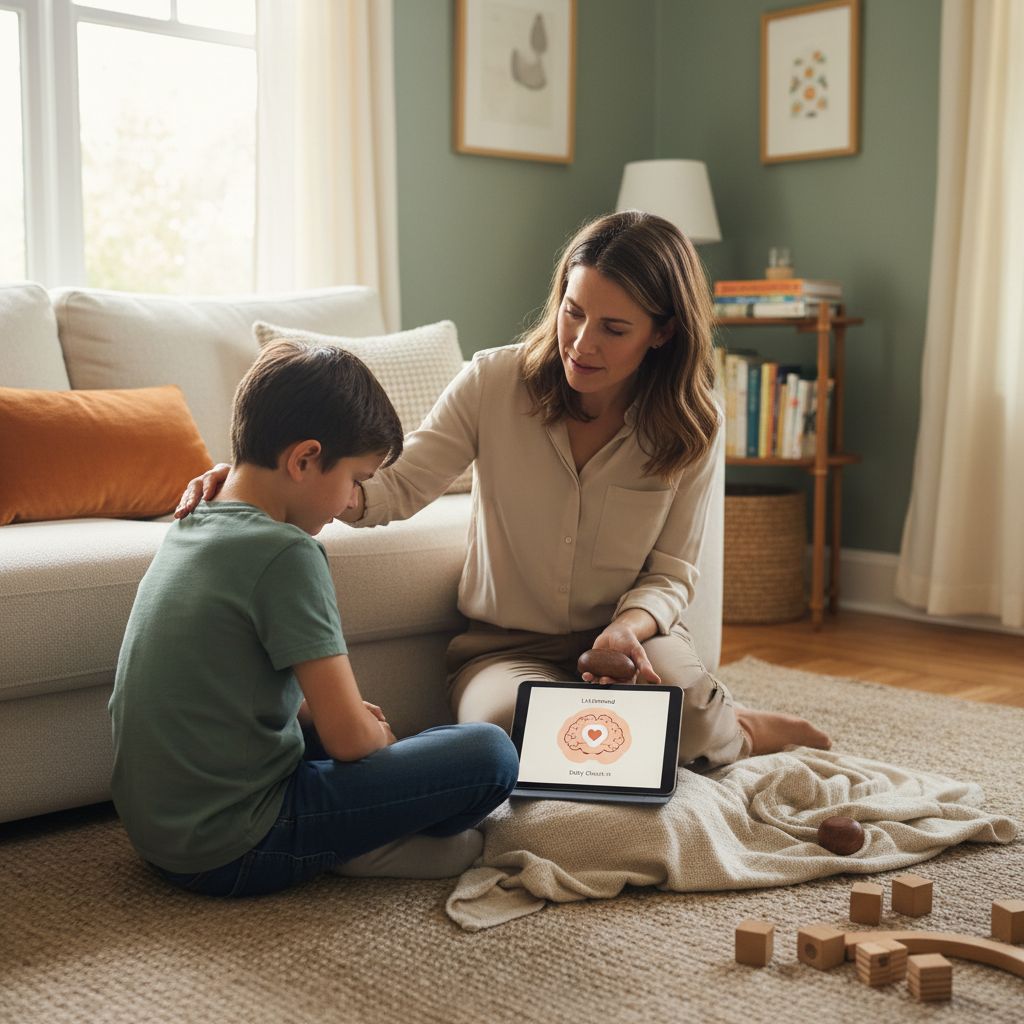
This is where co-regulation comes in. You become their external regulator. Stay close. Get on their level physically. Your calm nervous system helps settle theirs. Validate what they're feeling without fixing it: "You're really angry right now. I'm here."
Try the 'name it to tame it' technique. When you label the emotion, "That's disappointment" or "You feel left out", it actually reduces activity in the amygdala. The feeling becomes less overwhelming once it has a name.
Here's what doesn't work: teaching breathing exercises during the tantrum. Save the coping tools for later. After they've calmed down, that's when you can practice together. "Next time you feel frustrated, we could try taking three deep breaths. Want to practice now?"
Recovery gets faster with repetition. Each time you co-regulate, you're building their capacity to eventually do it themselves.
As you practice these techniques consistently, you'll start to notice shifts in how your child handles their emotional world.
Measuring Progress: What Emotional Growth Actually Looks Like
You won't see emotional growth happen overnight. But you will see patterns emerge when you know what to look for.
Ages 4-6: They start naming their feelings without prompting. "I'm frustrated because the blocks keep falling." They show basic empathy when a friend cries. They might use a simple calming strategy you've taught them, taking three deep breaths before asking for help.
Ages 7-10: They recognize emotions in others and adjust their behavior accordingly. They choose coping strategies independently (drawing, walking away, using words). They can explain why they felt a certain way and what they did about it.
Ages 11-14: They anticipate emotional triggers and plan ahead. They seek support when needed but also handle conflicts without adult intervention. They reflect on their emotional responses and consider alternatives.
Track these moments in a simple journal or notes app. When you review monthly, you'll spot progress that felt invisible day-to-day. Notice the effort, not just the outcome. Did they try the breathing technique even though they still melted down? That's growth.
Seek additional support if emotional outbursts intensify over three months, if they're struggling to make or keep friendships, or if anxiety interferes with daily activities. Normal development includes setbacks. Persistent patterns that disrupt functioning need professional eyes.
Start Where You Are: Your Next Steps in Supporting Child Emotional Development
Teaching emotional intelligence to children isn't about getting it perfect, it's about showing up consistently and creating space for feelings to be acknowledged and processed. The parent who models emotional awareness, even imperfectly, gives their child more than any curriculum ever could.
Pick one strategy from this guide and commit to it this week. Maybe it's adding an emotion word to your breakfast routine. Maybe it's pausing during a tantrum to co-regulate instead of immediately problem-solving. Small, consistent actions compound into profound change over time.
If you're struggling to identify the patterns driving your child's behavior, Littlemind removes the guesswork. Thirty seconds each day creates a clear record of what's really happening, mood shifts, sleep quality, behavioral changes, and life events, all in one place. During transitions like school changes, custody arrangements, or family stress, these insights become invaluable. The platform is completely judgment-free and privacy-first, designed to help you understand your child without adding more to your plate.
Understanding patterns is the first step to meaningful support. When you can see what's driving the behavior, you can respond with clarity instead of frustration. That's not just good parenting for today, it's building the foundation for your child's emotional resilience for life. Start today, and trust that each small moment of connection matters more than you know.
See what is behind the good and hard days
Littlemind is a 30-second daily check-in for parents of kids aged 4 to 14. Over a few days, gentle AI insights show you patterns in mood, sleep and behaviour, and what helps.