It's evening, and your child is on the hallway floor, refusing to put on their shoes. The clock is ticking, and you can feel your own voice getting tighter and louder. If you've been there, you're in good company.
That moment isn't a sign that you're doing something wrong. It's one of the most common spots in family life, and it's also one of the best chances to show your child what steady looks like.
This article walks through why your calm matters, what it looks like in practice, and the exact words you can try tonight, with ideas for every age from 4 to 14.
Why does your child fall apart even more when you are stressed?
It's 6:45 pm. One shoe is on. The other is somewhere under the couch, and your child is flat on the hallway floor, refusing to move. You can hear your own voice getting sharper with every "Come on, we're going to be late." You know it's not helping. You can't seem to stop.
You're not failing. This is a loop most families know well. Your child's meltdown ratchets up your stress, and your stress feeds the meltdown right back. This article helps you stay steady enough to break that loop. You'll get phrases and small steps you can use tonight.

It starts with co-regulation. Put simply, children borrow calm from the adults around them before they can produce it on their own. Your voice, your face and your breathing all send signals. When they're steady, your child's body gets the message that things are safe. When they're tight and rushed, that message gets lost.
Here's the reassuring part. Kids are still building this skill well into their teens, and it develops gradually. A child who falls apart at the door isn't a sign of bad parenting. And it's not a flaw in your kid, either. Organisations such as the Harvard Center on the Developing Child describe responsive, supportive relationships as a foundation for how children learn to manage stress. Every calm moment you offer is part of that foundation.
What does staying calm actually look like in the moment?
Knowing that your steadiness matters is one thing; knowing what it looks like when your child is mid-meltdown is another, so let's get practical.
Calm doesn't mean silent. It doesn't mean perfect, and it doesn't mean you feel nothing. You can be rattled inside and still be steady on the outside. What counts is this: your child shouldn't have to manage your reaction on top of their own.
Start with three small physical moves.

- Lower your voice. Slower and quieter, not louder.
- Drop your shoulders and unclench your jaw. You'll be surprised how much tension lives there.
- Breathe out slowly before you speak. Just one breath. That's all.
Next, change your position. Crouch down to your child's level or sit beside them. Side by side often feels less intense than face to face, especially for older kids who bristle at being looked at head-on. (Think of how much easier hard conversations get in a car.)
And if you need a beat, take it. Try saying, "I need a moment to take a breath, then I'm right here." That isn't walking away. It tells your child you're staying, and it shows them what regulating looks like in real time.
One gentle note. If you're exhausted, sensory-sensitive or neurodivergent yourself, your own regulation counts too. Noise, touch and chaos can hit you hard. Some days, steady will look messy. A good-enough response is plenty.
What can you say to help a child calm down, by age?
Once your body is steadier, your words can follow, and the right ones depend a lot on how old your child is.
Start with one rule. Connect before you correct. A child in the middle of a meltdown can't absorb a lesson, weigh a consequence or follow your logic. That conversation can wait. Right now, your calm is the whole job.
Ages 4 to 7
Keep your words short and concrete. Your body does most of the talking here.
- "I am here."
- "That was really hard. I've got you."
- "Let's breathe together. Smell the flower, blow out the candle."
Offer a hug or a hand on their back, but only if they welcome it. If they push you away, sit nearby instead. Being close without crowding still says you're not going anywhere.
Ages 8 to 11
Now you can name the feeling. Just don't try to fix it.
- "That sounds really frustrating."
- "You don't have to talk yet. I'll sit with you."
Then hand them a little control with a choice: "Do you want a quiet minute, or do you want me to stay right here?" Either answer works. What matters is that they get to steer, and that tells them they're being taken seriously.
Ages 12 to 14
Say less. Give more space, and leave the door open (literally, if you can).
- "I can see today was a lot. I'm around when you want me."
- "No need to explain now."
Skip the heart-to-heart for the moment. Offer something low pressure instead, like a snack, a walk or some music. Plenty of teens will talk later, on their own terms, once the pressure's off.
When words aren't the answer
Some kids calm down better without them. Many children with sensory needs or ADHD settle through movement, dim light or less noise. A jump on the trampoline, a darkened bedroom or a pair of headphones may do more than any phrase on this list.
So watch what works for your child, and trust it. You know them better than any script does.
What if you lose your cool too?
Even with the best phrases in your back pocket, there will be evenings when your own patience runs out.
You will lose your temper. Every parent does. You'll snap at the third "I'm not tired" of the evening, or you'll bark when your tween rolls their eyes for the fifth time. It doesn't make you a bad parent. It makes you a person.
And here's the good news. A rupture isn't the end of anything. What you do afterward matters far more than getting it perfect in the moment.
Wait until everyone is calm, then try a short repair. Keep it simple and match it to your child's age:
- Ages 4 to 7: "I got loud earlier. That was not your fault. I am sorry. I love you."
- Ages 8 to 11: "I was frustrated and I spoke too sharply. Let's try again."
- Ages 12 to 14: "I handled that badly. Can we reset? I would like to hear your side."
Why does this work? Because your child gets to see that big feelings can be survived and mended. That's a regulation lesson no lecture could teach.
So drop the guilt. The goal isn't a flawless this time. It's a steadier next time.
How can you make calm easier before the hard moment arrives?
The easiest meltdown to handle is often the one that never fully builds, so it's worth looking at what happens well before the hallway.
Most meltdowns don't come out of nowhere. They're the last drop in a very full cup. Hunger, tiredness, a long school day, a loud room, a rushed switch from one activity to the next. Stack three or four of those together and a dropped crayon becomes a catastrophe.
So start by looking behind the storm. Ask what the whole day looked like, not just the five minutes before.
Then build a few small routines that make calm the default:
- A quiet 10 minutes after school, with no questions and no demands
- A snack before homework starts
- A gentle wind-down before bed
Keep them boring and repeatable. That's the point.
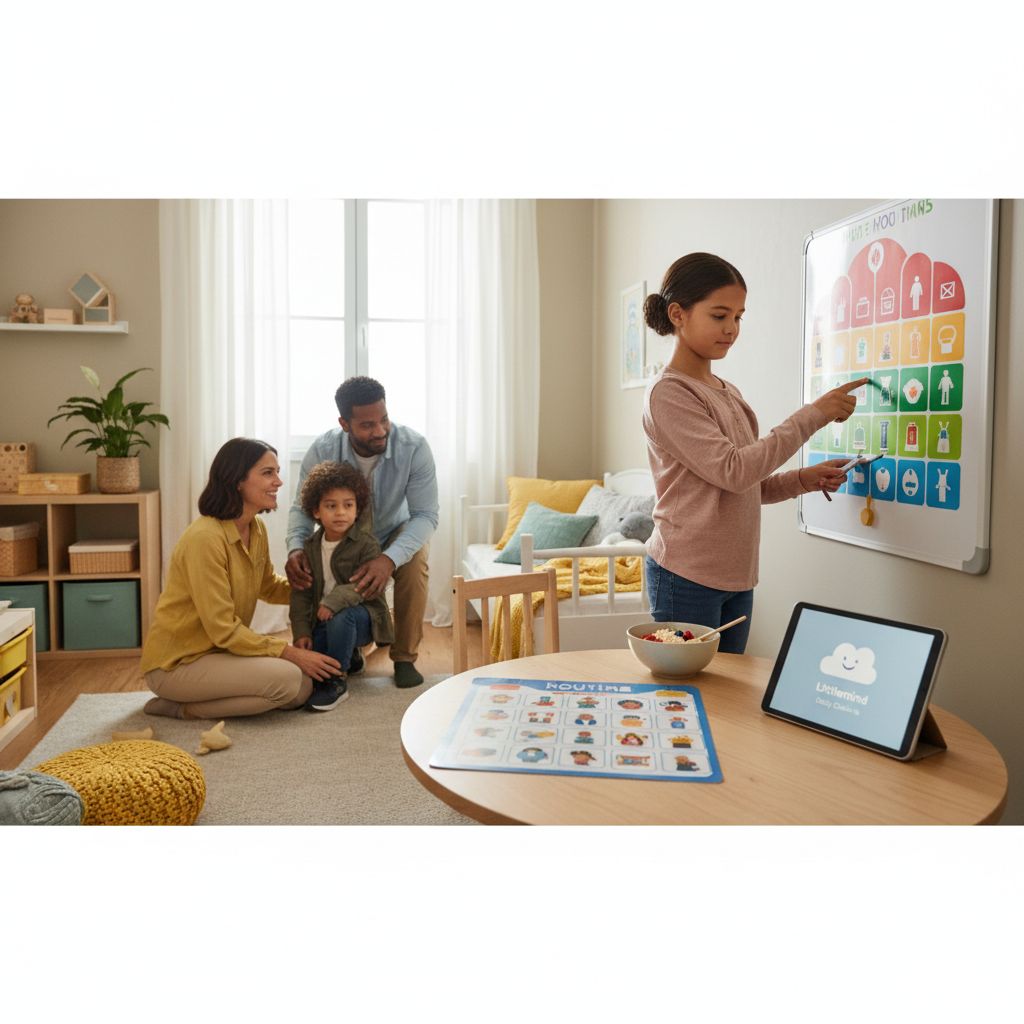
Practise your calming tools when everyone's relaxed. Try a breathing game, a cosy corner with cushions, or a feelings chart for younger kids. If your child meets these for the first time mid-meltdown, they won't work. If they already know them, they just might.
Watch for patterns over days, too. When do the hard moments cluster? What came before them? A short daily check-in on mood, energy, sleep and behaviour (a simple app like Littlemind can hold it for you) makes those links easier to spot. It also gives you something concrete to share with a professional if you ever need to.
And you don't have to carry this alone. Co-parents, grandparents and other trusted carers can all use the same short, calm phrases, so your child hears one steady message wherever they are.
When to talk to a professional
Sometimes home strategies, however thoughtful, aren't quite enough, and knowing when to ask for more support is part of good parenting.
Reaching out for help isn't a sign you've failed. It's a sign you're paying attention. Plenty of caring parents do everything right at home and still want a second set of eyes.
So what's worth raising? A few calm, specific signs:
- Big emotions that regularly disrupt sleep, school, friendships or family life for several weeks
- Meltdowns that are very intense or last a long time and don't ease with your support
- A child who seems worried or low most days
- Any talk of self-harm or feeling unsafe
That last one needs prompt attention. If you think your child is at immediate risk, contact your local emergency or crisis services right away.
For everything else, start with your child's pediatrician or GP. They can check in on the whole picture and point you toward a child psychologist or another specialist. The American Academy of Pediatrics, the NHS and the Child Mind Institute also offer parent guidance you can browse in the meantime.
Here's a practical tip. Before the appointment, jot down when hard days happen and what seems to help. A few weeks of simple notes (time of day, what came before, how long it lasted) can make the visit far more useful.
Co-regulation is a supportive everyday practice. It doesn't replace professional care when your child needs it.
Back to the hallway floor
Picture that hallway again: one shoe on, one shoe missing, your child on the floor and your voice starting to climb. Now picture a different version, where you take one slow breath, crouch down, and say, "I'm here. We'll get there." It won't fix everything, and it doesn't have to.
Calm is built from small, imperfect moments that add up over time. So pick one phrase or one step from this article and try it tonight. Then notice what seems to help your child. That's all, and it's plenty.
See what is behind the good and hard days
Littlemind is a 30-second daily check-in for parents of kids aged 4 to 14. Over a few days, gentle AI insights show you patterns in mood, sleep and behaviour, and what helps.